
Your child’s first dental visit is recommended when their first tooth appears, and by around their first birthday at the latest. Preparation is what makes the difference: talk about the dentist calmly and positively, pick a time when your child is well rested, and think of the first appointment as a chance to get to know each other rather than as treatment.
At what age should your child first see a dentist?
Paediatric dental societies recommend a first visit within six months of the first tooth coming through, and no later than the first birthday. The first tooth usually appears at around 6 months, although some children get theirs earlier and others later.
Many parents wait until their child is about three, or until they complain of pain. But then the first experience at the dentist is treatment, which makes it harder. An early visit, when nothing is wrong, helps your little one get used to the dentist at a calm moment.
Why do baby teeth matter?
Baby teeth fall out, but until then they do important work: they help your child chew and speak clearly, and they hold space for the adult teeth. Decay can progress quickly in baby teeth and lead to pain or infection. At a check-up we can spot early marks or risk areas and show you how to prevent problems.
How do you prepare your child for the first visit?
- Talk about the dentist naturally, as someone who “counts your teeth” and helps keep them healthy.
- Play dentist at home: they open wide, you count their teeth with a toothbrush, then swap. A children’s book about visiting the dentist helps too.
- Avoid scary words like “needle”, “pain” or “sting”, even in reassuring sentences such as “it won’t hurt”.
- Don’t use the dentist as a threat, as in “if you don’t brush, I’ll take you to the dentist”.
- Show them what the clinic looks like so the place feels familiar. You could look at our clinic page together.
- Choose a good time: when they’re rested and fed, not during nap time.
- Bring a favourite toy.
- Watch your own feelings. Children quickly pick up on a parent’s nerves. If you’re very anxious about the dentist yourself, it may be better for the other parent to come along.
What happens at the first appointment?
The first visit is short and, more often than not, involves no treatment at all. Usually:
- We talk with you about your child’s health and habits: bottle, dummy or pacifier, snacks, brushing.
- We let your little one look around, touch the chair and settle in. Very young children can sit on a parent’s lap.
- The dentist looks at their teeth, gums and bite.
- You get advice for home: how to brush their teeth, how much toothpaste to use, which snacks to cut back on and when to come back.
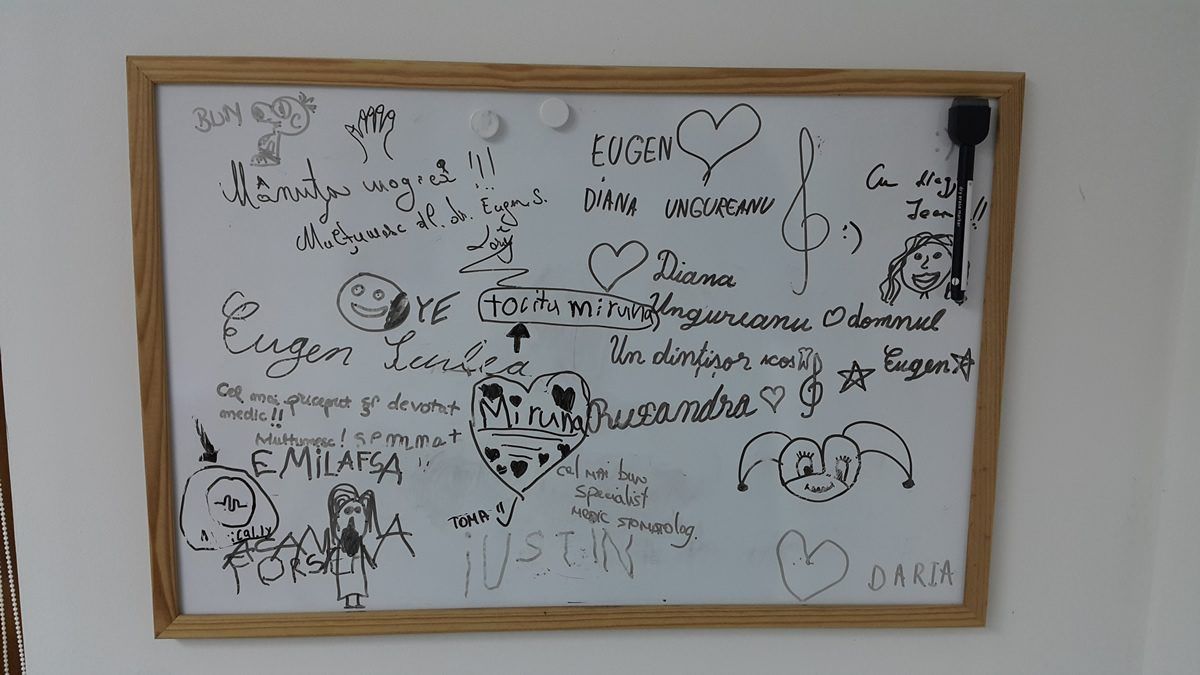
At our clinic in Brașov, Dr. Larisa Gligor treats both adults and children, and we take a patient approach with little ones and their parents. After the visit, children can leave a message on the board we keep for them in the clinic. You can read more about treatment for younger patients on our children’s dentistry page.
What if your child cries or won’t open their mouth?
That’s normal, especially for toddlers, and it doesn’t mean the visit has failed. Don’t scold them and don’t force them. We’re patient with children and with nervous patients, and sometimes the first appointment is simply about getting acquainted and spending a few minutes in the chair. Praise your child afterwards for being brave, however much they cooperated, and talk at home about what they liked.
How do you look after your child’s teeth between visits?
- Brush twice a day from the first tooth, with a fluoride toothpaste: a smear the size of a grain of rice up to age 3, and a pea-sized amount from 3 to 6.
- Brush their teeth for them, and as they grow, let them have a go themselves with you supervising, usually until around 7–8 years old.
- No bottle at bedtime with milk, juice or sweetened tea: it’s a common cause of decay in young children.
- Keep sweet snacks occasional and make water the main drink between meals.
- Check-ups every six months, or as your dentist recommends.
Around the age of 6, the first permanent molars come through. Sealing the grooves on their biting surfaces can help protect them from decay; we’ll tell you at a check-up whether it’s right for your child.
When should your child see a dentist straight away?
Don’t wait for the next check-up if:
- your child has toothache or can’t eat on one side;
- swelling appears on the gum or cheek;
- they’ve fallen and broken, loosened or knocked out a tooth; see also what to do in a dental emergency.
Chalky white or brown spots on the teeth aren’t an emergency, but they’re worth booking a visit for soon.
We see dental emergencies every day from 09:00 to 21:00 without an appointment; please call first on 0747 353 415. If swelling spreads towards the eye or neck, your child has a fever and seems listless, finds it hard to swallow or breathe, or has had a hard knock to the head, go straight to the emergency department or call 112.
Frequently asked questions
At what age should my child first see a dentist?
When the first tooth comes through, and by around the first birthday at the latest. An early visit, with no problem to fix, helps your child get used to the dentist and shows you how to care for their teeth at home.
How often should my child have a dental check-up?
Usually every six months, or as your dentist recommends based on your child's risk of tooth decay. Regular check-ups help spot problems early, when they are easier to treat.
Do baby teeth need treatment if they're going to fall out anyway?
Yes. Baby teeth help your child chew and speak, and they hold space for the adult teeth. Untreated decay can lead to pain and infection, and an infection can sometimes affect the adult tooth forming underneath.
What if I'm scared of the dentist myself?
You're not the only parent who feels this way. Try not to pass your nerves on to your child; if that's hard, another close adult could bring them. You're welcome to come for a check-up too: we're patient with nervous adults as well.
The information in this article is general and does not replace a consultation with a dentist. For a diagnosis and a treatment plan that suits you, book a consultation.